Oak Hill Park Deep History
Oak Hill's past is murky in many of its details. Rumors around town that the property had been a burial ground for local Miwok, Chinese, or Japanese are all unfounded.
Even though he didn’t have title, a Mr. Thompson “donated” land for a cemetery, possibly before 1855. In the early days no records were kept and plots were free. Later, a small fee was charged and written list kept but plots were not described or mapped. (In 1868, forty-six names were listed. Eighteen died of smallpox, two were “killed” and one was shot.) Fires would occasionally burn through the park, and wood headstones, which were often used, were destroyed or damaged.
In January of 1866, John McNear, a prominent citizen, lost his wife in childbirth. When her newly-dug grave filled with water, McNear found a more suitable spot at what is now Cypress Hill Cemetery. Thompson's Historical Atlas Map says McNear's Cypress Hill Cemetery was "laid off in 1872..." After that, Oak Hill fell into disuse. By June of 1879 the city prohibited further burials.
On May 23, 1900 Petaluma Courier reported that four months would be allowed for removals. After that time the graves would be “leveled off and all the fences and stones will be removed…” Certainly some were remains were left behind.
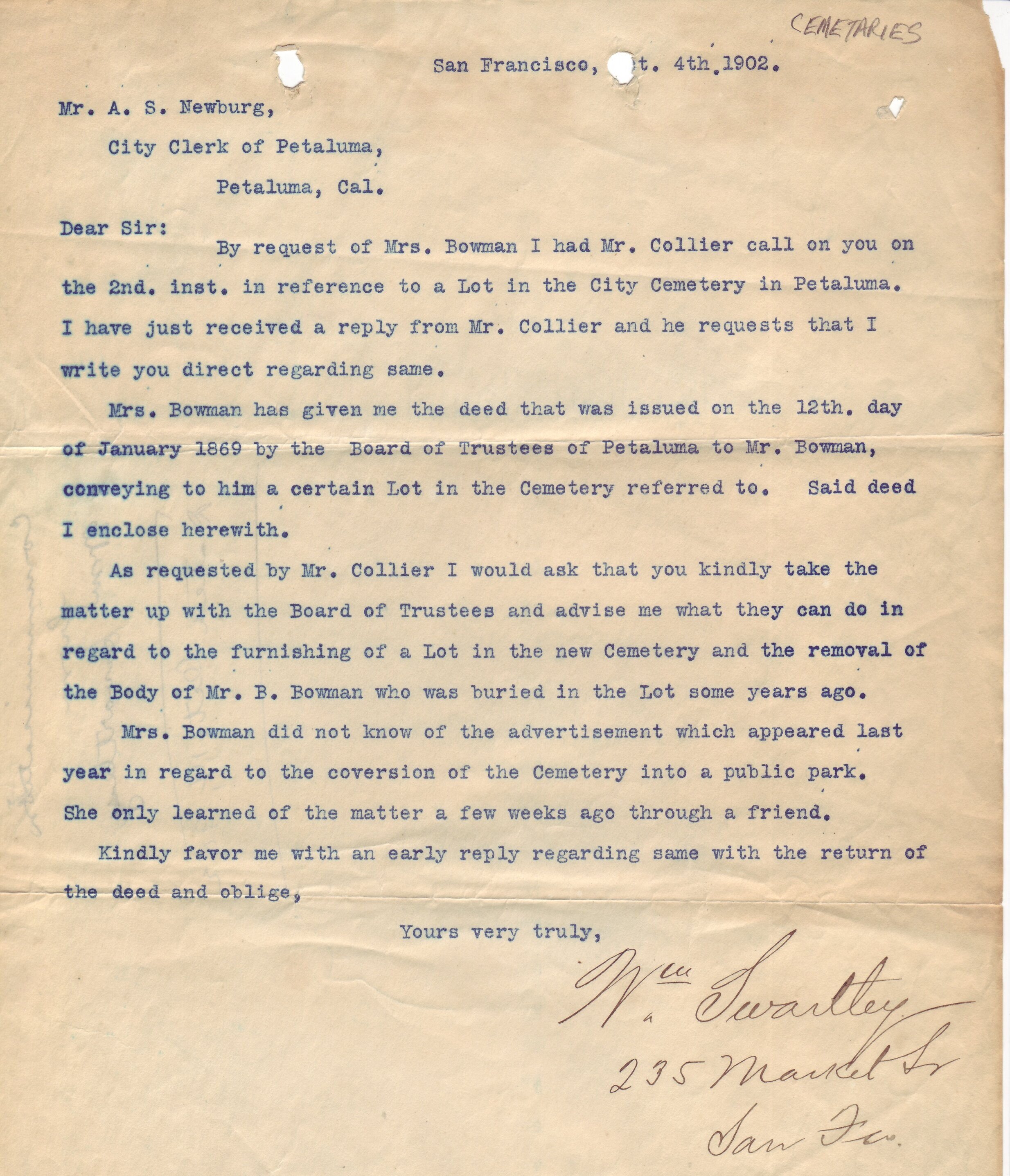
Unfortunate Mrs. Bowman wrote in 1902 wondering what happened to the plot of Mr. Bowman - she had been unaware of the change.
Were all bodies removed from Oak Hill Cemetery? With poor record keeping and the loss or damage of some headstones, it is unlikely that all the bodies were removed from the park. Confusingly, a 1948 ordinance states that all remains would be disinterred and the designation as cemetery officially and legally removed. By this time the park was well established.
A school was considered but the property title could not be established, thus the land remained for public use.
1900-1920
Some members of the Oak Hill Improvement Club were members of the Ladies Improvement Club - and that group knew how to get things done. Donations were made and the city was persuaded to provide monthly payments of $25 for the creation and care of a park. In addition to the stone wall along Howard Street (wall constructed by E.W.M. Evans), benches, gravel paths, and gravel roads were installed. A swing set was installed near Howard Street. (Lengths of granite curbing remain in the park and may date to this era.) A flag was donated by “Herman Church” and Mr. Kercheval put up a “fine” flagpole. Mr. Misner stepped up to fly the flag on holidays. (A flagpole still exists in the lower park but it is probably not the same one. It’s not known where the original pole stood.) Vandalism occurred frequently and the club members had to bolt down the picnic tables. A “neat little bungalow” was erected to house tools and shelter the hose cart, the latter having been donated by the fire department. The hose was put to much use and prevented small fires from spreading.
1915 brought new play equipment - see-saws of maple, “glides” and swings.
1930-1970
One wonders if the park fell into disrepair, or was simply considered unimproved by the community when a 1938 editorial was printed: Oak Hill is "almost in its pristine condition...Great possibilities here for improvement..." A tennis court would have been installed in 1938 but funds were insufficient.
At one time, Mr. Ron Barker said the scouts met in the park regularly in the 1940's. Mr. M. Avila reported that during World War II an annual "Jamboree at Oak Hill" was held at the park with a two night campout for 250-300 boys. Generally people remembered that much of the park was usually let go to tall weeds during that time.
In 1948 the City of Petaluma commissioned an ambitious Master Plan, addressing traffic, parking, land use and zoning, recreation, public works, existing facilities, and finances. Of the plan's 123 pages, 75 are devoted to the issues of parking and traffic.
In this spirit, then, it is no surprise that the plan recommended that Park Avenue be extended through the park to Park Avenue from Galland Street for "improved circulation." This did not occur, but it’s likely the gravel road was paved at this time. More interesting is the section on "Recreation.” The proposed plan is a busy one. The entire park is given over to active play. There are areas for handball, volleyball, horseshoes, tether ball, paddle tennis, archery, picnicking, wading, and a children's play area. Although that plan was not implemented, the lawn on the upper part of the park, picnic tables, and some play equipment were installed in the 1950s. By that time, the hospital district’s plan to establish a new hospital in the park were dashed.
As in many city parks of the 1950s and later, high school and college students were hired to operate summer recreation programs for local children.
There is a statement in the master plan that the site "has been leased to the Hospital District as the site for a new Community Hospital" The city attorney issued a report that was nearly identical to the city attorney's report of 1900; the title was not clear and the land could only be used as a park.
1970 - 2000
The next few decades saw no major changes in the park, but it was the site of frequent vandalism.
In the late 70s Oak Hill Park had become a rough area that appealed to troublemakers and transients; tires were burned, bottles thrown and hypodermic needles were scattered around. Following neighborhood organization to request patrols of the park, the temper of the park began to change, but it took several months to gain control, and the park slipped into a transient population spot again in the late 1980s.
Members of the neighborhood were again before the city in February of 1989, making a request that the city remove the street through the park to increase safety for children and families using the park. In the now-established tradition of volunteers taking an important role in park development, a landscape architect who lived across the street from the park, Walter Mahoney, recognized an opportunity to affect the future of the park.
Mr. Mahoney recognized that several majestic oak trees were dying due to irrigation around their roots. He and other interested neighbors formed The Oak Hill Park Citizens' Advisory Committee. (This part of the history of the park is familiar to me; my husband, Todd Gracyk, was very active in the committee.) Shortly after the committee was formed, Jim Carr became the Petaluma Parks and Recreation Director; he had had experience with oak restoration in Santa Rosa, California, and was sympathetic but had little funding to offer. Landscape architect Larry Reed soon offered his assistance.
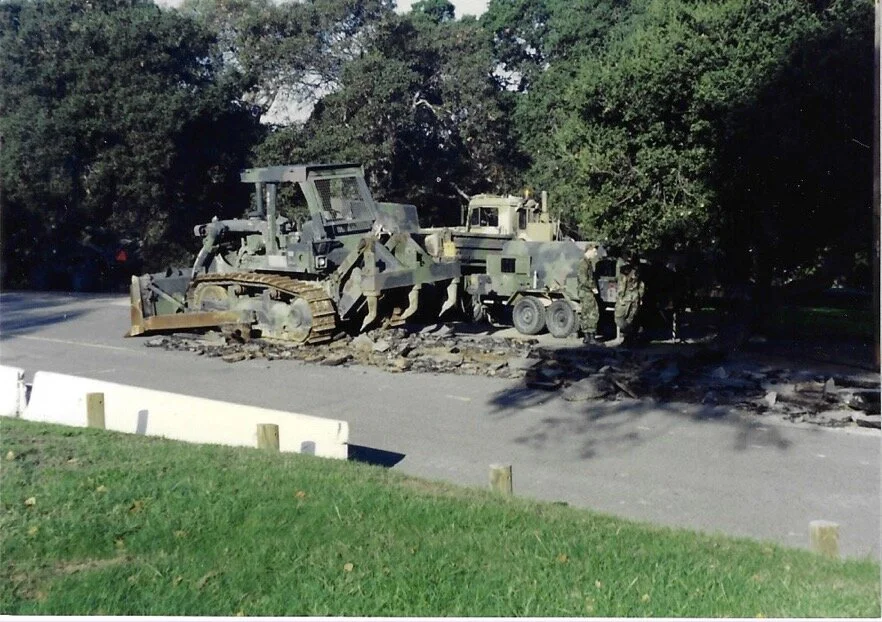
National Guard removing the road through the park. Photo by Todd Gracyk.
The road through the park was closed in 1989. An arborist was hired to assess the trees in 1990. Sixteen trees were in such poor health that they needed to be removed (two promptly fell over) and the remaining seventy trees required remediation. Petaluma People Services worked with Circuit Rider Productions to perform the work at a low cost. The California National Guard agreed to provide a crew to remove the road - a task that the city found too expensive. The city agreed to fund a master plan. Conceptual master planning was done on a volunteer basis by two landscape architects, Walt Mahoney and Larry Reed. Sometime later the city hired Sandra Reed of Z A C Landscape Architects to prepare the specific plan and oversee installation of the project. The implemented plan was reduced from the plan of 1991, due to budget restraints. Heritage Homes of Petaluma donated $5000 for benches and lights and various groups donated other funds. Colorful new playground equipment was installed. (Many of us miss the old snail-shaped climbing structure and the classic jump-and-spin merry-go-round.) Edwin Hamilton of Hamilton Stoneworks created the striking stone park sign along Howard Street.
In 1999 the Chamber of Commerce Leadership class added a 48’ circular labyrinth to the northeast corner of the park. Over fifty volunteers worked on the project. (It was featured in a display in Washington, DC, in 2000.) Sadly, in 2005, the oaks on the highest point of the park died and were removed. New trees were planted shortly thereafter.
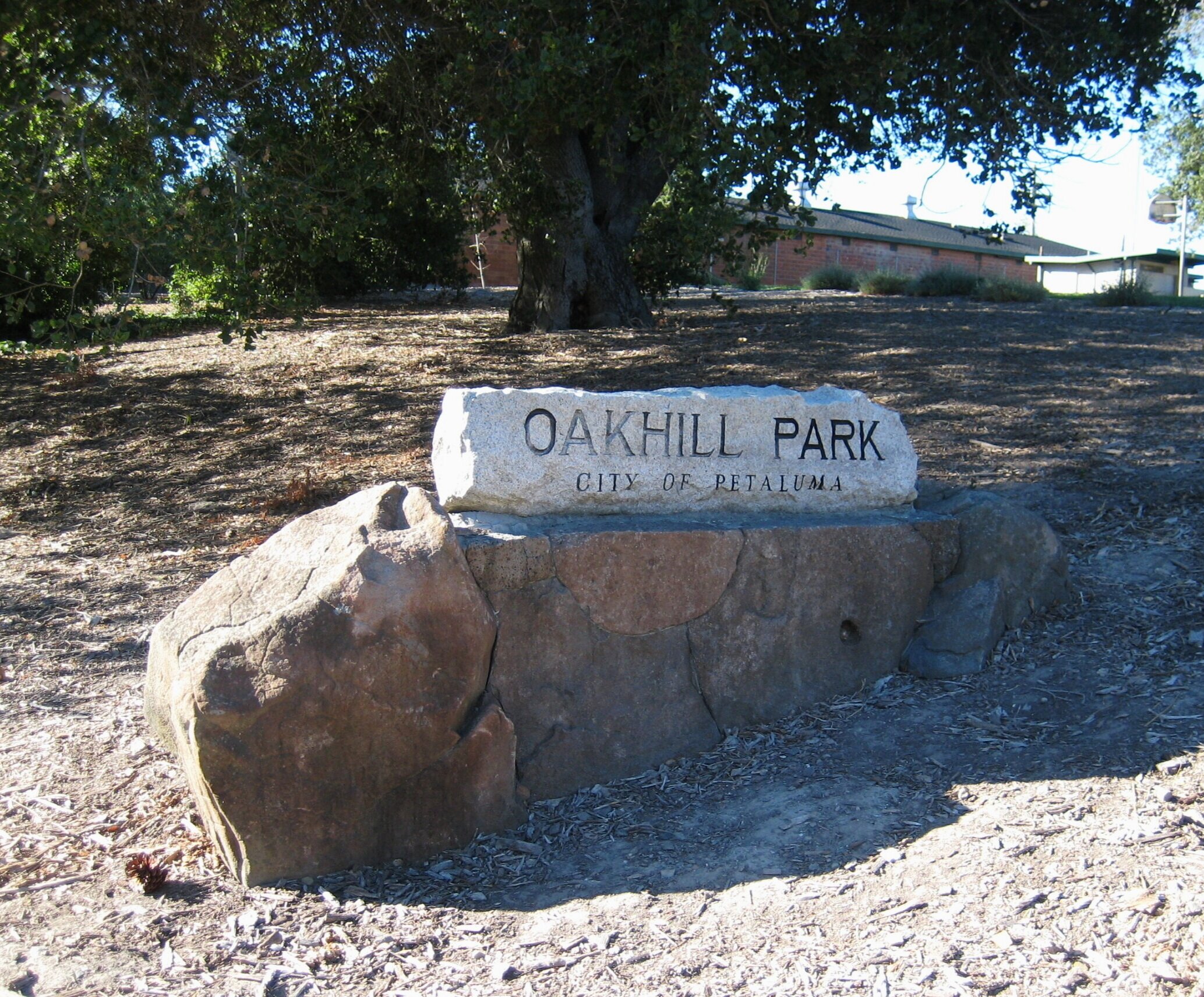
Stone signage by Edwin Hamilton. Photo by Janet Gracyk, 2012.