oak hill park
Once the main cemetery of Petaluma, this site has had uses thrust onto it by the needs of the town and is a particularly unique view into the attitudes of Petalumans towards its parks.
Originally used as a burying ground, it was formally named a cemetery by city ordinance in 1868. Burials ceased in 1878, after John McNear established Cypress Hill Cemetery in 1872. By 1900, City Leaders wanted to build a school at the property and advertised that remains should be removed from the old cemetery, but records suggest that this did not occur in all cases.
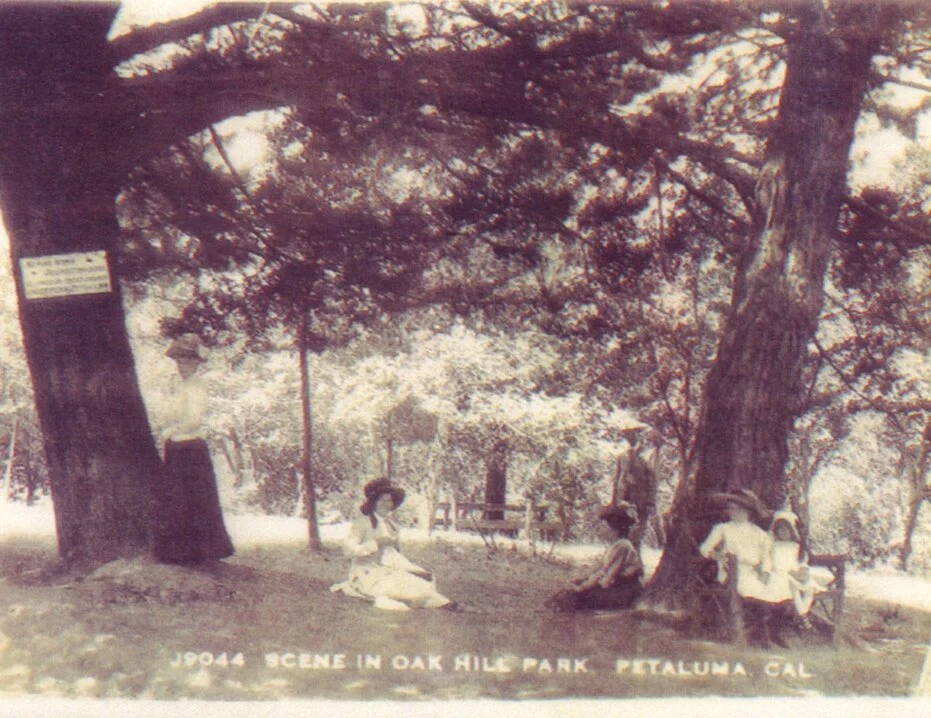
Oak Hill Park postcard. From the collection of Janet Gracyk.
The city attorney, in researching title to the land, determined that the original donor of the land did not have a legal title to it, and the property could not be developed. The land fell into further disrepair.
Local women, following the example of Petaluma's Ladies Improvement Club, formed the Oak Hill Improvement Club in 1908. Through fundraisers, and a small donation from the City, the club installed a stone wall along Howard Street, pathways, a gravel road, and other small features. Rather than creating a formal park, similar to the two existing parks in town, this club chose to retain the somewhat wild character of the land, making minimal changes to it.

Photo by Thomas Floyd Colvin, possibly taken in 1954. “Oak Hill Park, Petaluma, California, about 1954.” Courtesy of the Sonoma Co Library.
The 1948 Petaluma General Plan had ambitious goals for the park, proposing a road through the park. The road may have been a remnant of that created by the Improvement Club. A busy program was created for the rest of the park - handball, archery, tennis, and a wading pool were some of the programs expected to be offered. This was during a time when park managers across the country were keenly focussed on creating many activities. Funding likely limited the plan to planting grass and building a narrow road through the park that skirted a newly added swing set. It’s know that Boy Scouts sometimes used the lower park for overnight camping, scaring each other with tales of the dead lying under them.
By 1989, native oak trees that can’t tolerate summer water and had been surrounded by lawn began to die. As is often the case in this community and others, it took a group of citizens to head up an effort to revise the park.
It took a few years and many volunteer hours. The roadway was removed and a new play area and lawn were created. The lower park became a popular dog park. A local group of Petanque enthusiasts received permission to create a Petanque court in the upper park.